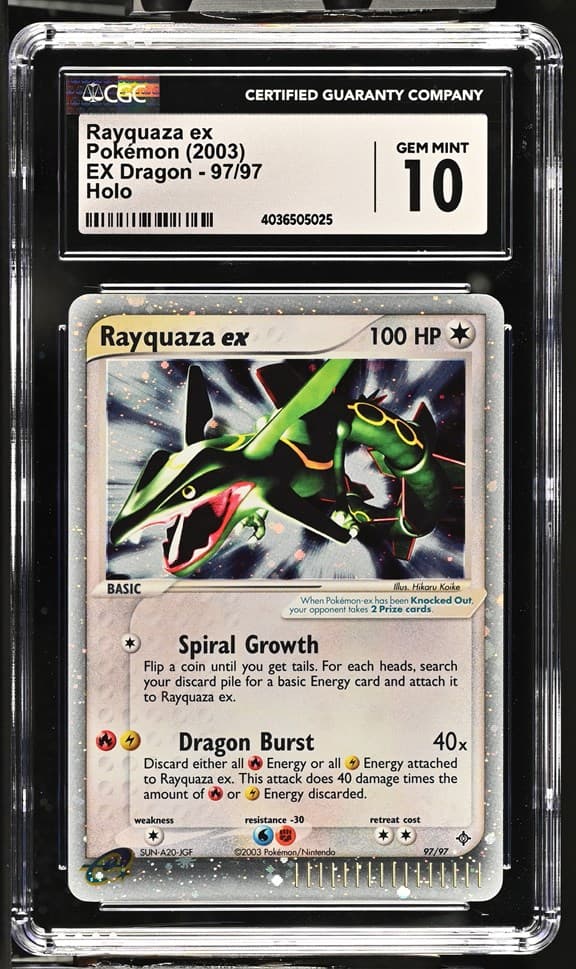
I love these people, immediately pumping the stuff they buy
Meanwhile pristines used to be underrated.
Now they sell for PSA prices and people hop on the bandwagon
I love these people, immediately pumping the stuff they buy
Meanwhile pristines used to be underrated.
Now they sell for PSA prices and people hop on the bandwagon
its pretty hilarious how cheap they used to be stuff like 1st ed base went for what cgc “gem mint” does now in like 2022-23 
The 2025 mind could never comprehend this picture
Yep @zorloth got a whole bunch of skyridge pristines back then for like what PSA 6 prices are nowadays. Outrageous and really clean cards
And now he is retired on fat bread stack street
Yeah, I actually ended up selling most of them because the prices became way too absurd (they increased by like 2 to 5x) and I don’t care that much about Skyridge. I only decided to even bid because they were all auctioned off at once and it was clear the market had no appetite for them.
What’s funny is that basic CGC 10s didn’t actually move much in price since then. It’s just CGC pristines and PSA 10s.
The current prices of CGC pristines and PSA 10s are, IMO, insanely irrational compared to what basic CGC 10s (aka old label 9.5s) and PSA 9s sell for.
If CGC pristines were consistently in better condition than CGC basic 10s, and if PSA 10s were in consistently better condition than PSA 9s, then I think the value differences would make complete sense.
But these grading companies are just not very competent. Or at a minimum, not nearly consistent enough to justify these premiums.
One example to illustrate my point:
That Snorlax is on PWCC right now. I own a CGC 9.5 basic with the original deep blue label (38xx cert). I guarantee you my copy would sell for literally 1/5th the price of the CGC pristine, despite the fact that (1) my copy was literally pulled from a pack in 2020 and (2) the “pristine” copy on PWCC literally isn’t even NM, let alone mint, let alone gem mint, let alone pristine lol.
In other words: you could (theoretically) purchase 5x pack fresh Rocket’s Snorlax exs for $x OR you could purchase 1x moderately played condition Rocket’s Snorlax ex for $x that a provably incompetent third party slapped a prettier label on.
It’s against my financial interests to say this, but it’s for this reason that I’ve been seriously considering downgrading my CGC pristines into CGC basic 10s. The whole thing has just become so laughable. It’s the exact same irrationality that exists with PSA 10s vs PSA 9s. It’s the same thing that drove me to convert my PSA 10 sets into CGC 9.5 sets to begin with.
If I had to build my collection from the beginning at today’s prices, I would either go for (1) PSA 9 sets or (2) CGC basic 10 sets. I’d avoid PSA 10s and CGC pristines like the plague.
Interesting. Sounds like a cope to me, I’ve never seen a PSA 10 that looks like that
Side note, I continue to hate GPT. Reading the body of that reddit post is a trip, it couldn’t be more GPT if it tried
I actually remember seeing this copy when it originally sold. I think it sold for around 2k immediately. I expect this was a PSA 9 reslabbed, it has surface scratches, front and back, and a corner chip.
In my experience Pristine 10s on average look better than normal 10s. Normal 10s quite often have surface scratching. but Pristine 10s are a mixed bag, it seems like some people at CGC just give them out to their friends or something. Some are good/better than PSA, some are absolute shitshows like the Lugia, and to a lesser extent, this Snorlax
My experience is pristines are better only marginally, and that the overlap is unacceptably large. Speaking very approximately: if you had a representative sample of pristines and a representative sample of basic 10s and you chose 1 at random from each sample, the pristine has something like a 60% chance of being in better condition than the gem mint.
Depends what you mean by “quite often.” It’s not uncommon at all, in my experience, to find CGC gem mint 10s with clean surfaces. Although I’m not going to lie: I do use a bit of a trick to filter out CGC gem mint 10s with surface issues–by never buying CGC gem mint 10s with corners/edges that appear literally flawless. When a CGC gem mint 10 has perfect corners/edges, you can know with near 100% certainty that there’s some surface scratching. My success rate on nice surfaces is much higher when I only buy gem mint 10s with a white corner dot on at least two corners.
Also, in my experience from having first collected PSA 10 sets before moving them over to CGC: there’s a massive overlap between PSA 10s and CGC gem mint 10s. People seem to have this perception that CGC gem mint 10s are nearly always worse than PSA 10s. Not my experience at all. My experience is that the idea that PSA (or CGC) is anywhere near consistent enough for there to not be massive overlap is clearly wrong (obv you didn’t claim this, but just speaking generally).
I think cgc realized our brains see pristine labels and go “Oooh shiny gold, pretty” and want the card more. I’m fully convinced a majority of the popularity in cgc pristine 10s is the well designed label and not much more.
I’m in the same boat as you and have been snatching up higher grade cgc grades (not pristine though) for much less then their psa equivalent prices but seemingly similar card quality.
Although I agree with a lot of what you’re saying. This statement seems to run at least somewhat counter to your earlier claim that grading companies are inconsistent.
At the very least they’re applying at least some standards somewhat consistently if you can predict the quality of the surface of a card with near certainty based on the overall grade and the condition of the corners alone.
CGC (and PSA) are both pretty consistent when it comes to the corners and the back edges (in other words: whitening). The condition issues I find on CGC pristines (and on PSA 10s, when I collected them) are almost invariably either related to (1) surface or (2) edge issues on the front of the card.
So basically they aren’t consistent when it comes to assessing the overall condition of a card. CGC in particular will rarely overlook whitening, but will often overlook surface/front edge flaws. I’ve found that CGC tends to pretty reflexively give a card either gem or pristine if it has almost no whitening, which seems to often result in them overlooking surface/front edge flaws.
Also: I should be more clear that when I say ‘inconsistent,’ I don’t mean inconsistent in the same sense that a low-feedback eBay seller would be inconsistent. I mean inconsistent in the sense that a grading company–who claims to be able to differentiate between card conditions with a high degree of precision–would be inconsistent.
Basically, it’s not like CGC and PSA are routinely giving cards gem mint that actually deserve PSA 4s; it’s just that neither company is nearly as precise as they would have to be to justify the condition premiums that people pay.
cgc non-pristine is prolly still down tbh
Do we know if graders look at cards or the scans?
Feels like this would be true if graders graded based on scans
Graders examine cards, not scans.
However, I do believe that QA would be improved if they looked at the scans before shipping. You can see certain types of damage more easily on the scans.
That’s a very interesting possibility that I hadn’t considered.
Honestly, this would totally explain why they often miss the front top edge peeling on exs, because it’s typically not visible in scans but it’s very obvious when looking at the card in person. Same with surface wear.
Although it couldn’t be true all of the time because I do have cards with grades (that appear to be) based on condition issues that don’t appear in scans.
We know that this is what companies claim, but do we actually know it for a fact? TBH, it wouldn’t shock me if grading was based on scans (at least some of the time), because it would also reduce the risk of liability for a grader mishandling a card and damaging it + it would dramatically reduce the time required per card. And it would also explain why CGC is particularly lenient on the attributes @banks mentioned.
For instance, this card has surface scratching AND top edge peeling, but they aren’t that apparent (except very subtly) in the scans:
Anyway, not saying I’m convinced, but it’s not totally implausible either.
you gotta pay extra for them to look at the actual card vs just a scan
Cgc and PSA look at cards or scans? I thought it was just a random number generator
Historically, we do. There have been card grader AMAs and youtube videos in the past 5-10 years, and none of them have mentioned scans to my knowledge. Of course, technology advances quickly and grading companies are known to use employee NDAs, so it’s possible that scans or more advanced imaging technology have been integrated.
If it is used, I would expect it on higher-tier submissions for grade guarantee insurance purposes rather than the average bulk submission.
Publicly discussing advances in grading technology at PSA and CGC may be more of a liability (due to competition) than a marketing strength these days, but I hope it becomes a regular occurrence. CGC was really the first company to mention their use of XRF scanning, UV analysis, etc., and I was really happy to see that.