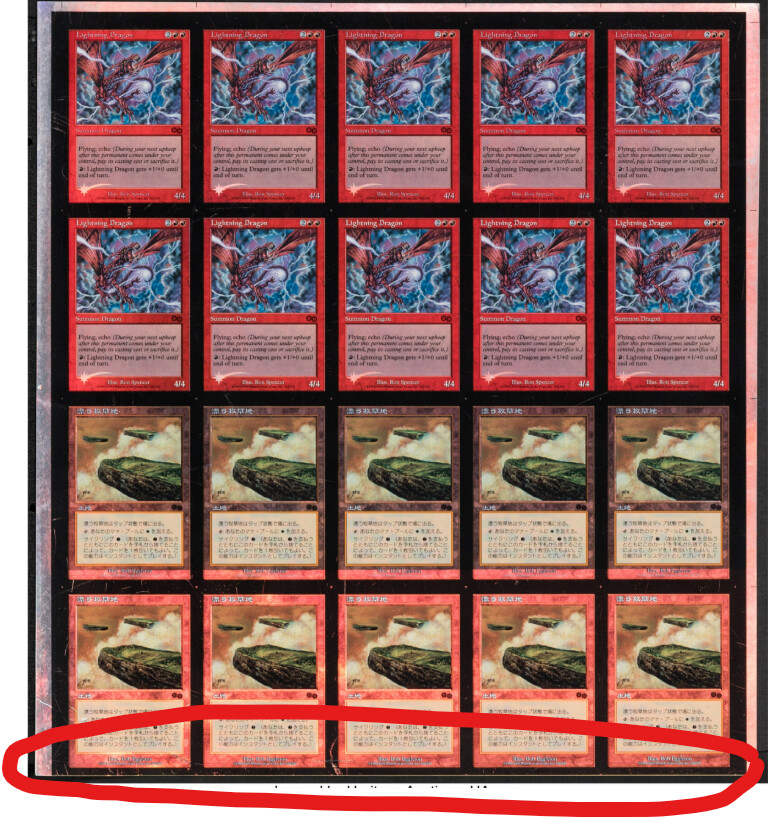
The owner of that row would NEVER consider using scissors.
Other people have used scissors, and also pinking shears, to cut sheets in the past, but this method produces very low quality results, so it’s a bad idea.
Anyone can submit cards to the grading companies, but I don’t know of any grading company that would accept offset press cards that had been cut with scissors.
The cards would just be rejected.
To get a card graded, the quality of the cut needs to be good enough that the grading company can’t tell that it wasn’t cut in the original factory.
The CGC scandal in early 2025, revolved around Pokémon Playtest Cards from Japan.
Near as I can tell, it was caused by one of the creators of Pokémon TCG being untrustworthy, and CGC not sufficiently double checking his statements with other Pokémon TCG creators.
There’s 3 ways to authenticate an item.
- Witness the creation yourself. (trust yourself)
- Talk with someone (preferably multiple people) who witnessed the creation. (trust an authority)
- Compare the fine details of the suspect item to a known real item. This only works if you’ve established a suitable known real item for comparison, which usually requires using method 1 or 2.
CGC Signature Series autographs are a good example of method #1. CGC witnesses the autograph.
Usually it’s not practical for a grading company to witness the creation of a trading card, so they go to method #2 and interview the various people who were involved in creating it, because those people recognize their own workmanship.
This is the necessary method for authenticating rare cards that weren’t intended for public distribution.
For the regular cards that did have public distribution, it’s usually pretty safe to assume that cards personally opened from sealed product, are authentic, and are suitable for comparison to suspect cards using method #3.
This is how an authenticator builds a library / database of known real cards, which is essential for method #3
Method #3 is what’s typically used to authenticate regular cards. It only works if you have a suitable known real card to compare with.
With enough experience, you can memorize some of the known real details, but whether you’re using a physical card, a saved image, or your memory, it’s still a comparison.
The Pokémon Playtest scandal was unpleasant for everyone involved.
CGC (rightfully) took a big hit to their reputation, and their bank account.
But the CGC Authenticity Guarantee system worked more or less as intended.
Of the people who wanted to purchase Pokémon Playtest cards, the people who purchased CGC graded examples, are WAY better off than people who purchased raw examples.
But the Japanese Pokémon Playtest card scandal has practically nothing to do with these English WotC Test Prints that were graded years before.
Any collector who is seriously interested in extremely rare cards like these, should understand the big difference between Playtest cards and Test Prints.
Here’s a video for anyone who wants to learn more about the differences.
https://youtu.be/piQpaAKyPrM?si=qkU5EA28e7FJcPDj
I posted all the Blastoise Test Print sales data above, and you can see the price decline even before the public became aware of the Playtest scandal. I think the price decline is mostly related to how many “uncut” sheets have surfaced missing the bottom row, and fear that those missing cards might hit the market and hurt the value further.
It’s supply and demand. Fear of a flooded market, has hurt the demand, and it will take time for that fear to ease.
Eventually, someone will want to buy one of these Blastoise Test Prints, because it’s the first English Pokémon card, and the origin of all WotC Pokémon cards. That buyer will have to make a deal with one of the existing owners.