Rumored to be distributed by the same people who sold the other Alpha / Beta / Delta Prototype and Playtest test prints were these Double-sided “No Opaque Layer” test prints:

One side is printed with a “flat” foil:
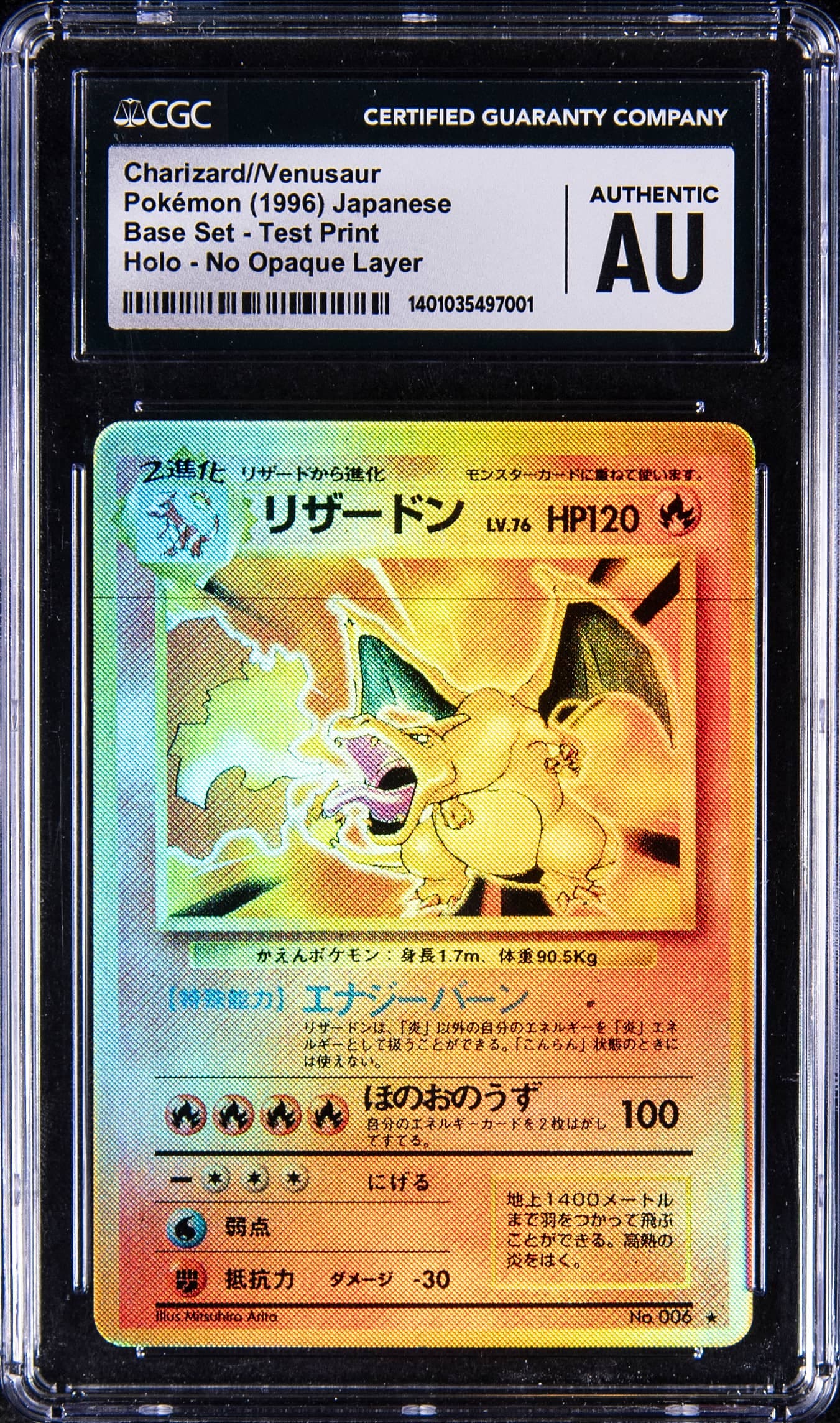
The other side (and inverted) has the cosmos foil used in the Japanese base set:

Because these allegedly came from the same sources who distributed the very-likely fake prototypes and sheets, the authenticity of these have come into question. They’ve been sold publicly on platforms like Fanatics, Goldin, and RareCandy. I know these have not proliferated as widely as the other items in the “Akapocalypse”, but they have sold publicly so it’s worth making this post in case those owners want some analysis done.
I was provided a scan of a Magneton test print, along with a personally pack-pulled base set Japanese Magneton. These were placed on the scanner bed and scanned at the same time, hopefully eliminating hardware scan differences:

Here are both cards overlaid on top of each other. Other than having slightly different centering due to the the cut, everything matches up

Now let’s zoom in and take a look at the rosette patterns and black vector layer.
Real card

Test print

First of all, the vector layer is crisp and doesn’t bleed into the rosettes, so it looks like it was printed with a separate K plate, which is a good sign of offset printing.
It’s hard to see, since the holo covers much of the printer surface, however if you look at the rosette patterns in the light parts of the holo, you’ll see that they are identical to the real card’s. This is especially apparent if you isolate color channels like magenta. The same repeating diamond pattern is at the right size across the card.
Real card

Test print

Lucky for us, Magneton also has a lot of holo surface area, so we can use that to determine if the holofoil is the same material. Let’s examine the two cards in the exact same location
Real card

Test Print

You can see that the holo patterning is identical across both cards, with similarly-sized small “flecks”, and “spheres” of identical shapes. The rosette pattern also looks the same when highlighted under the holo.
You might notice that the test print has “seams”. These are noticeable if you zoom out slightly:

This is just what I’ve been told, but reportedly these test prints were ordered to check for what the cards would look like when they caught the edges of the holofoil sheet. We see this even on modern Pokemon cards as well, since holofoil sheets might not span the whole sheet and need to be “tiled”:

(Thanks @queendrifloon for this example of a holofoil edge)
Why is this relevant? Let’s look at the reverse of a double-sided print:

This Poliwrath shows where 4 holo sheets join together. If you look at some other double-sided test prints, many of them also have these lines. Not all of them have them (at least from the low res scans), so again this is just a rumor

Anyways, let’s go back to examining the Poliwrath we have a hi-res scan of. This is the “flat holo” side of the double-sided print:

The rosettes appear consistent here with real Pokemon cards, and the black layer is sharp and separated from them so it looks like this was printed using an offset printer. You can see that in this Poliwrath, the yellow layer is slightly misaligned so it shows. This at least means it’s printed via a digital art file on an offset printer and not a photocopier.


The flat holo pattern is quite strange, we have no real reference for it–it appears almost scaley.
So what can we conclude this these scans?
Similar to my previous post on the uncut Snap sheets: Number 1 Trainer trophy printed on "uncut sheet" appears to have been printed in 2024 - #75 by HumanForScale, the findings here summarize as:
- The cards were printed from a digital art file using an offset printer in a fashion that is similar, if not identical to real Japanese base set cards.
- The rosette patterns are identical to real Japanese base set cards.
- Offset printing does not encode any date / time metadata that we know of, so we can’t say for certain when these cards were produced.
This does not conclusively tell us when they were printed, but they were definitely printed with similar equipment and an layered original art file. I will also note that these test prints have a rarity symbol on them, implying that they were likely created after the initial No Rarity print run.
If the story is true, perhaps after the initial run, they noticed the print lines from the holofoil sheet joins and ordered this batch of prints to see “how bad” they really were.


