Ex Unseen Forces
Ex Unseen Forces has it all: Gold Stars, a secret rare and “special” cards - in this case, the Unown - inserted in the reverse slot. That makes putting together the rarity table rather complicated, and these three types of cards need to be looked at first before doing so:
The simplest question is that of Celebi ex, the secret rare. The sample from Youtube (10 boxes) is too small to say anything definitive about the rarity. But given the fact that the set includes 13 Pokémon-ex that can be pulled from booster packs (including Celebi ex), all of them are already quite rare, so personally I doubt Celebi ex was artificially made even rarer by printing it fewer times on the sheet than the other Pokémon ex. 13 Pokémon ex would mean 6 with EX9 and 7 with EX8 rarity, and I am going to assign Celebi ex EX8, or 1 in 185.6 packs, as its “best guess” rarity.
Next, the Gold Stars. I wrote in my introductory post on the Gold Stars that they seem to take the place of a Pokémon-ex in this set, just like in Ex Team Rocket Returns. The individual boxes on Youtube looked as follows:
- 3 had 9 holos and 3 Pokémon-ex
- 3 had 9 holos, 2 Pokémon-ex and 1 Gold Star
- 1 had 8 holos, 3 Pokémon-ex and 1 Gold Star
- 1 had 10 holos and 3 Pokémon-ex
- 1 had 11 holos and 3 Pokémon-ex
- 1 had 11 holos and 2 Pokémon-ex
For this reason, and also because of the fact a number of Gold Stars from this set were apparently stolen from a printing facility, I am assuming the average box has 9 holos, 2 2/3 Pokémon-ex and 1/3 Gold Stars, though (as with most other sets) “error” boxes are quite common.
Finally, the Unown. Since the reverses in this set have a special holofoil pattern featuring Poké Balls and the Unown don’t, they must have been printed on a separate sheet. Their rarity is about 1 in 5 packs (the Youtube data yielded 72 Unown in 360 packs, exactly 1 in 5), but this poses a problem with the sequence length of 216 packs I am going with. As mentioned in the very first post in this thread, I chose this length (which signifies the number of packs after which the pattern with which certains types of cards are inserted into packs starts to repeat) so I could fit all the observed rarities for Generation 1 to Generation 5 sets into the sequence. Gold Stars seem to be about 1 in 3 boxes, the Ace Spec cards from Plasma Storm and Plasma Blast are about 1.5 per box or 3 in 2 boxes, the Alph Lithograph cards from Unleashed, Undaunted and Triumphant are about 1 in 6 boxes on average. Using a sequence length of 216 packs (which also corresponds to 1 case of 6 boxes) for all sets fits very well, though of course the sequence length may easily vary between sets. 216 however is not divisible by 5, so there are different solutions to model the rarities in this set:
- change the sequence length from 216 to 540, with 5 Gold Stars and 108 Unown. Gold Stars are 1 in 108 packs (3 boxes) and Unown are 1 in 5 packs.
- keep the sequence length at 216, with 2 Gold Stars and 43 Unown. Gold Stars are 1 in 108 packs and Unown are 1 in 5.02 packs, the closest to 1 in 5 you can get with this sequence length.
- keep the sequence length at 216, with 2 Gold Stars and 42 Unown. Gold Stars are 1 in 108 packs and Unown are 1 in 5.14 packs, which is exactly 7 per box on average.
I chose to go with the second option, though any of the three is perfectly possible.
The rarity table looks as follows (“O” denoting the box topper, Rocket’s Persian ex):
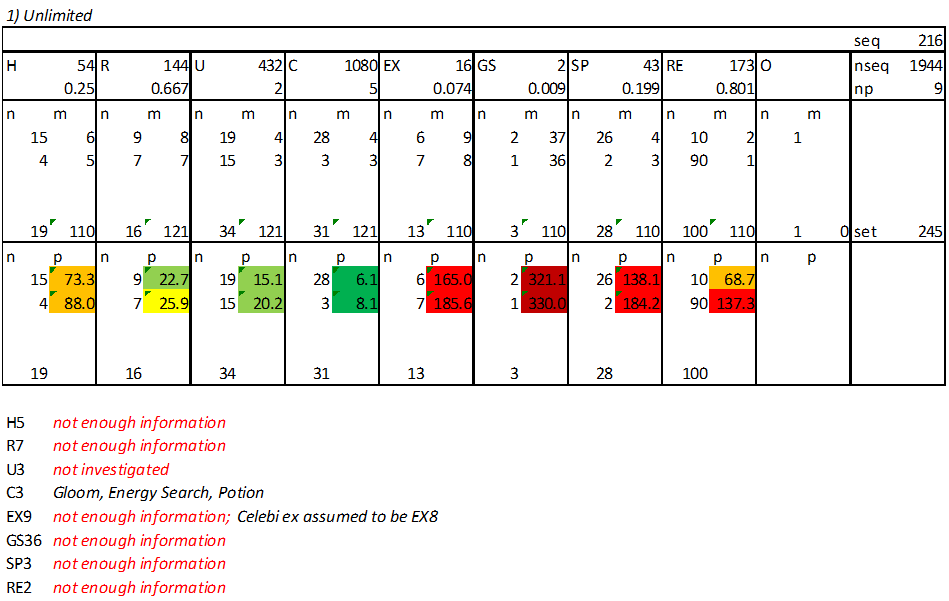
As can be seen, the set contains quite a lot of very rare cards: Gold Stars, Pokémon-ex, the Unown and also the reverses. It is also the first set since Skyridge where all the rares are rarer than all the uncommons.
The raw data for the holos, rares, Pokémon-ex and Unown is as follows (dashed lines indicating where the transition from H6 to H5, R8 to R7, EX9 to EX8 and SP4 to SP3 would occur:
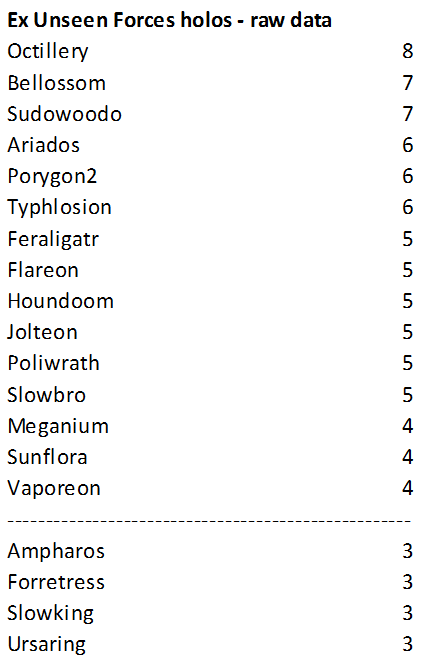
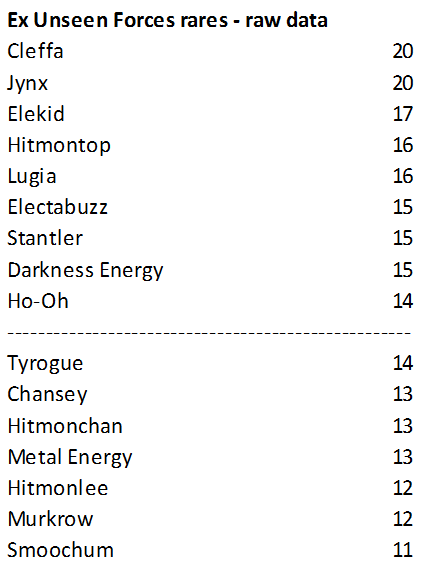
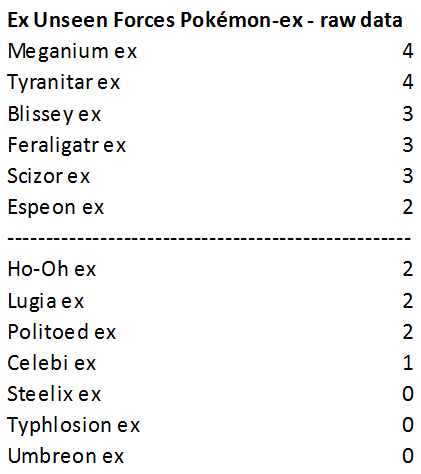
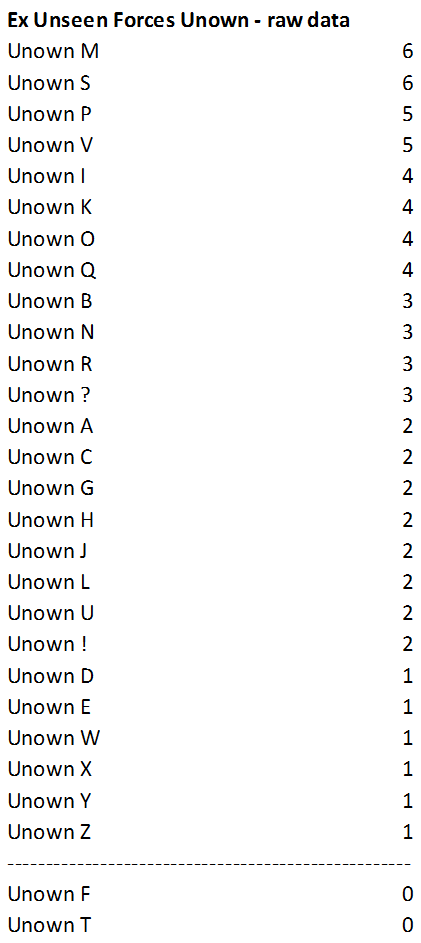
The sample is too small to say anything certain about individual card rarities.
I did not look at the uncommons, but was able to reconstruct the commons sheet. It looks as follows:
† Gloom, Poliwag, Teddiursa, Pineco, Gligar, Totodile, Oddish, Houndour, Flaaffy, Natu, Snubbull, Remoraid, Chikorita, Potion, Mareep, Slugma, Poliwag, Sunkern, Clefairy, Slowpoke, Gligar, Chinchou, Onix, Snubbull, Chikorita, Poliwhirl, Flaaffy, Pineco, Hoothoot, Houndour, Pupitar, Eevee, Oddish, Slugma, Chinchou, Remoraid, Gligar, Hoothoot, Porygon, Totodile, Pineco, Energy Search, Mareep, Spinarak, Gligar, Poliwhirl, Sunkern, Slugma, Natu, Wooper, Flaaffy, Potion, Slowpoke, Remoraid, Pineco, Larvitar, Onix, Teddiursa, Totodile, Oddish, Clefairy, Pupitar, Poliwag, Energy Search, Snubbull, Teddiursa, Spinarak, Mareep, Larvitar, Cyndaquil, Gloom, Chinchou, Houndour, Potion, Natu, Porygon, Eevee, Onix, Poliwag, Flaaffy, Oddish, Totodile, Wooper, Porygon, Chikorita, Slugma, Larvitar, Eevee, Cyndaquil, Sunkern, Hoothoot, Pupitar, Wooper, Gloom, Natu, Clefairy, Remoraid, Eevee, Wooper, Poliwhirl, Teddiursa, Cyndaquil, Porygon, Onix, Houndour, Slowpoke, Sunkern, Clefairy, Chikorita, Cyndaquil, Mareep, Spinarak, Hoothoot, Snubbull, Poliwhirl, Chinchou, Energy Search, Larvitar, Spinarak, Pupitar, Slowpoke †
As to the reverses, as usual I compared raw data with models using a 110 card and a 121 card sheet and filling out the “extra” spaces with commons, and the 110 card sheet continues to fit the raw data better:

An that concludes what I can say about this set.